
For Soccer Insider
By Kareem Rae, CEO, One Soccer Nation
December 30, 2025
If you want to understand how professional soccer clubs get built, financed, and scaled in the United States, you cannot start with formations or player recruitment.
You start with four building blocks:
- Market selection
- Ownership and local credibility
- Stadium control and revenue rights
- Supporter culture and community buy in
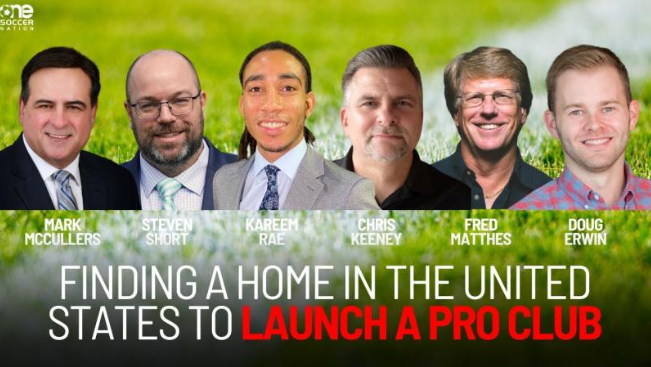
On a recent One Soccer Nation (OSN) panel discussion, I sat down with a group that has lived this process from multiple angles, league expansion, stadium development, club ownership, MLS operations, and supporter culture building:
- Steven R. Short (formerly Lexington Sporting Club, and previously 13 years at United Soccer League (USL) leading expansion and club strategy)
- Mark McCullers (President and Founder, McCullers Group, sports real estate advisory across USL stadium projects)
- Doug Erwin (Vice Chairman and Chief Brand Officer, Greenville Triumph SC and Greenville Liberty SC, USL League One and USL W League)
- Chris Keeney, MBA (A3 Sports Consulting and United Sports Property, MLS and USL background, former club owner in Tucson)
- Fred Matthes (GM, Annapolis Blues FC, former D.C. United and Sacramento Republic FC executive, longtime club builder)
Below are the key investor and operator insights that stood out, and the practical playbook they point to.
1) How investors actually find club opportunities
A lot of people assume there is a single “pipeline” for investing in U.S. soccer. The reality is messier and more human.
Steven’s answer was simple: it varies.
Sometimes it is a cold inbound from someone who hears a market is heating up. Sometimes it is a network referral from someone already inside the sport. Sometimes it is the league pushing a market and trying to match it with a credible ownership group. Sometimes it is an existing club, but those deals are usually controlled at the club level, not by the league.
The investor truth: good opportunities cluster around people, not websites.
That is why conference lobbies, informal meetings, and trusted relationships keep showing up as the real marketplace.
2) The Greenville case study: how a club can start “by accident,” then scale on purpose
Doug explained that Greenville’s opportunity basically fell into their lap through local relationships and early league interest in the market. That point matters.
Greenville did not become successful because the market magically “loved soccer.”
It worked because:
- The league already saw the market as strong
- The ownership group had deep local credibility
- The club committed to operating like a real business, not a hobby
Chris added the detail that matters most to investors: when a respected local family or leadership group backs the project, the market often responds faster because trust is already built.
Operator lesson: you do not just sell tickets, you inherit a reputation. If your ownership group carries trust, you start with a head start.
3) Engaged local ownership is a cheat code
This came up repeatedly. There is a direct correlation between engaged local ownership and club success. Why?
Because the earliest stage of a club is not about soccer. It is about:
- Relationships with city leadership
- Chamber of commerce and business community ties
- Sponsorship sales and local partnerships
- Navigating permits, sites, and development politics
- Building a real fan base, not just a launch day crowd
Fred framed it clearly using Sacramento: the builder in that market was not just an investor, he was a connector across business, politics, and community. That connective tissue is what makes the club real.
Investor takeaway: money is required, but legitimacy is the multiplier.
4) Out-of-market ownership can work, but absentee ownership is the killer
Doug asked the right question: what happens when local ownership is not available?
The panel’s view was nuanced:
- Out-of-market ownership can work
- Minority shares and local partners can fill the gap
- The club must hire strong local leadership
- Ownership must still show up and engage periodically
- The front office must have authority and resources to execute
Steven put it bluntly: absentee ownership is the worst-case scenario.
Operator takeaway: if ownership is not local, you must compensate with elite local leadership and structured engagement in the market.
5) Stadium control is not a nice-to-have, it is the business model
Mark laid out the stadium reality that every serious investor must understand: Private developers are not building lower division soccer stadiums across the country for one reason: most do not pencil without public private partnership tools. That is why the stadium conversation usually becomes a finance and incentives conversation:
- Tax increment financing
- Hospitality taxes
- Development incentives
- Negotiated operating agreements
- Long term leases that do not crush the club on day one
Mark’s key point: you need responsible stadium funding and a lease structure that supports long term sustainability.
Doug added the operator pain point: when you do not control the venue, you lose revenue and exposure:
- Concessions
- Parking
- Merchandise opportunities
- Broadcast quality and scheduling
- Date control and conflicts
- The ability to host other events
And the hidden cost that operators know well: painting fields, removing lines, conversion logistics, and the constant friction of being second priority.
Investor takeaway: a club without venue control is often a club without margin.
6) The real upside of venue control is not your 20 home dates
Steven made the best framing for investors: A team may have 20 home matches. A venue can have 200 revenue opportunities. If you control the stadium, you can host:
- Tournaments
- High school and college events
- Concerts
- Rugby
- Corporate rentals
- Community events
- Sports tourism programming
Owning or operating the venue turns the club from a ticket business into a year round asset manager. That is why the Atlanta Braves development model keeps getting referenced across American sports.
Operator takeaway: the club becomes the anchor tenant, but the venue becomes the platform.
7) Soccer authenticity matters more than people admit
Fred raised a point that every investor should factor into brand building and broadcast growth: Soccer looks better, feels better, and sells better when it is played in a soccer specific environment. Football lines, bad sightlines, and baseball conversions hurt:
- Viewer experience
- Broadcast optics
- Brand perception
- Sponsor appeal
- Supporter culture energy
This is not just aesthetics. It is product quality. If the goal is long term growth, the product must look and feel legitimate.
8) Supporters are not an accessory, they are early-stage infrastructure
The panel’s supporter segment was one of the most important for operators. Chris and Fred both described how supporter groups should be invited into the process early:
- Where they want to sit
- How they want to enter
- What rituals they want to build
- How the club can support without controlling them
- How the club can unify groups that may compete with each other
One line that stuck with me: A house is just a house until a family moves into it and makes it their own. That is the stadium and supporter relationship in one sentence.
Doug also made a practical point investors should remember: groups like the American Outlaws can be an immediate signal of soccer density in a market. They can help validate demand early, and they often become an early mobilizing force.
Operator takeaway: supporters are not a marketing tactic, they are a community operating system.
The Soccer Insider takeaway: The real blueprint for launching a pro club in the U.S.
If you are an investor or operator evaluating a U.S. pro club opportunity, here is the core playbook this panel reinforces:
Step 1: Validate the market beyond population
Look for growth curve, civic pride, competition density, and local soccer infrastructure.
Step 2: Build an ownership group that carries local trust
Even if capital is external, local credibility must be embedded.
Step 3: Solve stadium control early
Not eventually. Early.
Step 4: Build the club around community engagement, not just game day
The club is the connector. The venue is the platform.
Step 5: Invite supporters into the process
You are not building a crowd. You are building culture.
In Closing
Soccer in the U.S. is entering a phase where infrastructure, real estate strategy, and community alignment will define the winners, not just on field performance.
If you are trying to launch, invest, or scale in this ecosystem, the question is not “can this market support soccer?”
The question is: Can you assemble the ownership, stadium, and culture stack to make the club sustainable?


